



Can a High Court Direct Police Investigation Under Article 226 When Statutory Remedies Exist?
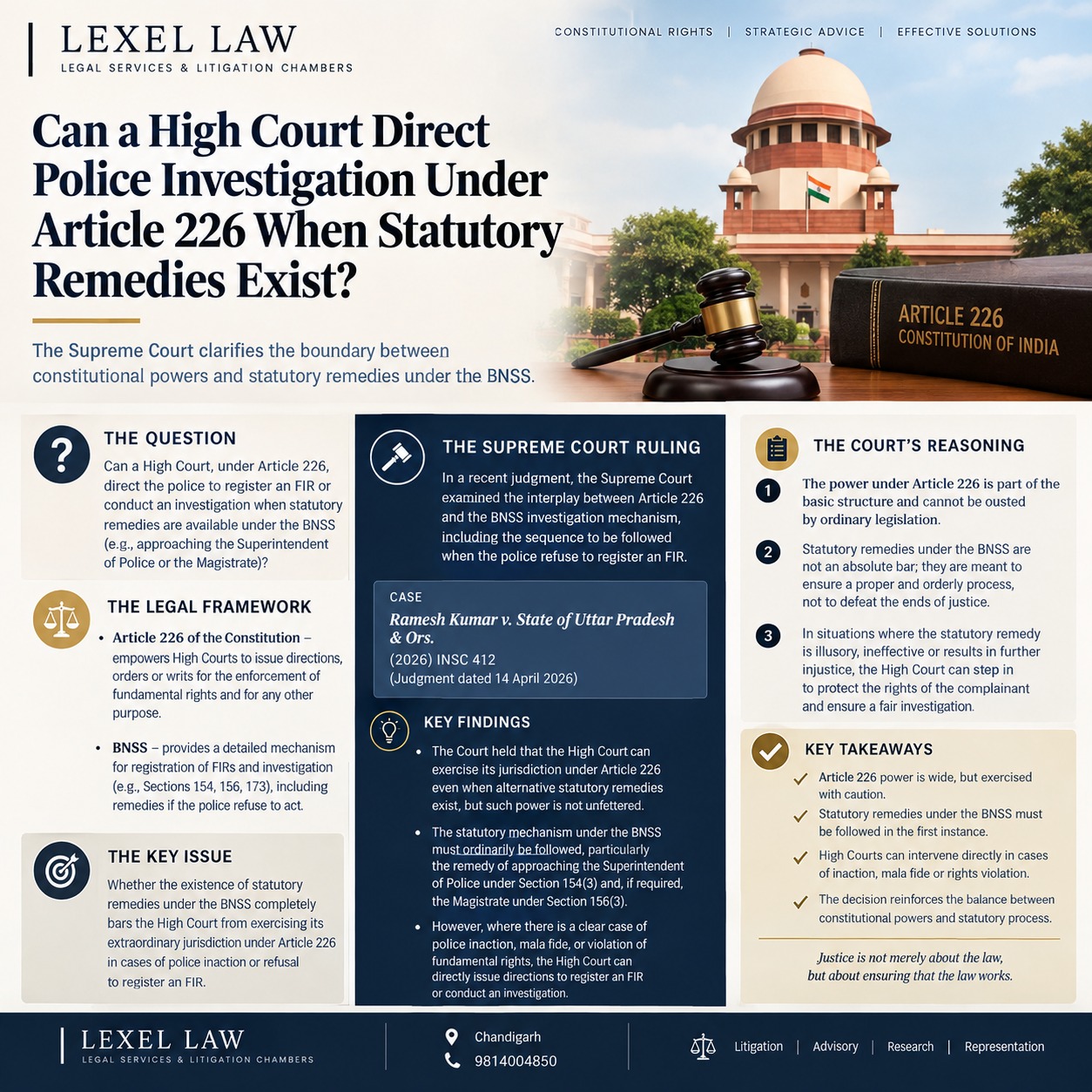
Can a High Court Direct Police Investigation Under Article 226 When Statutory Remedies Exist?
Understanding the Supreme Court’s 2026 Ruling on Article 226, FIR Registration and the BNSS
The power of a High Court under Article 226 of the Constitution of India is among the broadest constitutional remedies available to individuals seeking judicial protection against unlawful State action. At the same time, criminal procedure provides its own statutory mechanisms for dealing with refusal to register an FIR or failure to conduct a proper investigation.
The coming into force of the Bharatiya Nagarik Suraksha Sanhita, 2023 (BNSS) has made this relationship particularly important. The BNSS establishes a structured mechanism under Sections 173 and 175 for approaching the police and, where necessary, the Magistrate.
A significant question therefore arises:
Can a person directly approach the High Court under Article 226 seeking registration of an FIR or a direction for police investigation when the statutory remedies under the BNSS have not been exhausted?
The Supreme Court addressed this issue in Sujal Vishwas Attavar & Anr. v. State of Maharashtra & Ors., 2026 INSC 442, decided on 4 May 2026. The Court held that, ordinarily, where equally efficacious statutory remedies are available under the BNSS, a person should pursue those remedies before invoking the extraordinary writ jurisdiction of the High Court.
The judgment is important for understanding not only FIR registration but also the continuing relationship between constitutional remedies and statutory criminal procedure.
1. Article 226: A Wide but Discretionary Constitutional Power
Article 226 empowers High Courts to issue appropriate writs, orders and directions for the enforcement of fundamental rights and “for any other purpose.”
Consequently, the jurisdiction is wider than a remedy restricted exclusively to fundamental rights.
However, the width of the power does not mean that a High Court must exercise it in every case.
The Supreme Court has repeatedly recognized that Article 226 jurisdiction is extraordinary and discretionary. Courts have developed the rule that where an effective and efficacious alternative statutory remedy exists, the High Court ordinarily expects the person to pursue that remedy before invoking writ jurisdiction.
Importantly, this is not an absolute jurisdictional prohibition.
In Radha Krishan Industries v. State of Himachal Pradesh, (2021) 6 SCC 771, the Supreme Court summarized the principles governing the alternative-remedy rule. It recognized that the existence of an alternative remedy does not itself remove the High Court’s constitutional jurisdiction. Ordinarily, however, the statutory remedy should be pursued. The Court also identified recognized exceptions, including enforcement of fundamental rights, violation of natural justice, proceedings without jurisdiction and a challenge to the vires of legislation.
Therefore, two propositions have to be kept separate:
Article 226 remains constitutionally available; but its exercise may be declined where an effective statutory remedy has not been exhausted.
2. What Does the BNSS Provide When Police Do Not Register an FIR?
The BNSS creates a sequential mechanism for dealing with information concerning cognizable offences.
Section 173(1) BNSS
The first step ordinarily involves approaching the officer-in-charge of the police station with information relating to the commission of a cognizable offence.
This is the starting point for the criminal process.
Section 173(4) BNSS
Where the officer-in-charge refuses to record the information, the aggrieved person may send the substance of the information in writing to the Superintendent of Police.
The statutory scheme therefore provides an escalation mechanism within the police hierarchy.
Section 175(3) BNSS
If the grievance continues, the statutory framework provides for approaching the competent Magistrate.
Under Section 175(3), the Magistrate may, after considering the application supported by an affidavit under Section 173(4), making such inquiry as considered necessary and considering the submission made by the police officer, order an investigation.
The sequence is therefore broadly:
Police Station → Superintendent of Police → Magistrate
This structure is significant because it provides a statutory judicial remedy before constitutional writ jurisdiction is ordinarily invoked.
3. The Supreme Court’s Decision in Sujal Vishwas Attavar
The principal 2026 decision is:
Sujal Vishwas Attavar & Anr. v. State of Maharashtra & Ors.
2026 INSC 442
Decided: 4 May 2026
Bench: Justice Sanjay Karol and Justice Augustine George Masih
The case arose from a dispute involving property and allegations concerning forged documents, impersonation and related acts.
The complainant company had made complaints before the concerned authorities and police. However, instead of proceeding through the statutory mechanism contemplated under the BNSS, it approached the Bombay High Court under Article 226 seeking, among other reliefs, a direction concerning registration of an FIR.
The High Court passed an interim order directing the complainant company’s director to appear before the police for recording of her statement and directed that necessary action be taken according to law. Following this direction, an FIR was registered.
The persons against whom the FIR was registered approached the Supreme Court.
The central question before the Supreme Court was whether the High Court could effectively direct police action through Article 226 when the statutory remedies available under the BNSS had not first been pursued.
4. What Did the Supreme Court Hold?
The Supreme Court reiterated that Article 226 should ordinarily not be invoked in the first instance where equally efficacious statutory remedies are available.
The Court specifically considered the position where:
- an FIR has not been registered; or
- an FIR has been registered but proper investigation is allegedly not being conducted.
The Court held that the ordinary remedy in such circumstances is to use the statutory framework before approaching the High Court.
The Court emphasized that the BNSS provides a structured sequential mechanism:
Section 173(1) → Section 173(4) → Section 175(3)
In other words, the complainant should ordinarily begin with the police station, approach the Superintendent of Police where necessary, and thereafter approach the competent Magistrate.
The Supreme Court found that the complainant in the case before it had not exhausted these statutory remedies and had instead directly invoked the writ jurisdiction of the High Court.
In the absence of circumstances such as imminent danger to life or liberty, the Court considered the direct writ petition premature.
The Supreme Court consequently set aside the impugned interim order and quashed the FIR registered pursuant to that order, while leaving the parties at liberty to pursue alternative remedies available in law. The Court expressly clarified that it was not expressing an opinion on whether the underlying facts disclosed the commission of any criminal offence.
5. Is Article 226 Completely Barred in Such Cases?
This distinction is critical.
The judgment does not hold that High Courts lack jurisdiction under Article 226 whenever the BNSS provides an alternative remedy.
Rather, the principle is one of self-restraint and exhaustion of statutory remedies.
The Supreme Court relied upon the established jurisprudence governing alternative remedies, including Radha Krishan Industries, Thansingh Nathmal v. Superintendent of Taxes, Whirlpool Corporation v. Registrar of Trade Marks, and other authorities.
The alternative-remedy rule is therefore not an absolute ouster of Article 226 jurisdiction.
Exceptional circumstances may justify direct constitutional intervention.
These can include circumstances recognized in the established Article 226 jurisprudence such as:
- enforcement of fundamental rights;
- violation of principles of natural justice;
- lack of jurisdiction;
- challenge to the constitutional validity of legislation; and
- other circumstances where the statutory remedy is not an effective or efficacious remedy.
The specific facts and urgency of each case remain important.
6. Earlier Supreme Court Position: Sakiri Vasu
The 2026 decision also builds upon an established line of Supreme Court authority.
In Sakiri Vasu v. State of Uttar Pradesh, (2008) 2 SCC 409, the Supreme Court considered the appropriate remedy where a police station failed to register an FIR or where investigation was allegedly inadequate.
The Court explained that the complainant could approach the Superintendent of Police and thereafter the Magistrate under the then applicable Section 156(3) CrPC.
The Court emphasized that the Magistrate possesses significant powers to direct registration of an FIR and ensure proper investigation.
The 2026 judgment applies this established principle to the corresponding BNSS framework.
The change from the CrPC to the BNSS therefore does not mean that the underlying constitutional principle has disappeared.
Instead, the new statutory provisions provide the current procedural framework through which the principle operates.
7. Sudhir Bhaskarrao Tambe and the High Court’s Role
The Supreme Court also relied upon Sudhir Bhaskarrao Tambe v. Hemant Yashwant Dhage, (2016) 6 SCC 277.
That decision followed the reasoning in Sakiri Vasu and emphasized that a person complaining of non-registration of an FIR or inadequate investigation ordinarily has a remedy before the Magistrate rather than approaching the High Court directly.
The rationale is institutional as well as procedural.
The statutory criminal-procedure framework assigns particular responsibilities to the police and Magistracy. Allowing every grievance regarding FIR registration or investigation to begin directly before the High Court could bypass that structure.
The 2026 decision therefore reinforces the principle that constitutional jurisdiction should not ordinarily become the first procedural stop in an ordinary FIR-registration dispute.
8. Why the BNSS Sequence Matters
The statutory sequence under the BNSS has practical importance.
A complainant who approaches the High Court immediately under Article 226 may face a preliminary objection concerning maintainability.
The question may not necessarily be whether the complaint is true or false.
Instead, the immediate question can be:
Why was the statutory mechanism not followed?
This means that litigation strategy under the BNSS should carefully document the procedural history.
A complainant should ordinarily be able to demonstrate:
- what information was given to the police;
- when it was given;
- how the police responded;
- whether Section 173(4) was invoked;
- what response was received from the Superintendent of Police;
- whether an application was made before the Magistrate under Section 175(3); and
- why constitutional intervention is nevertheless necessary, if Article 226 is subsequently invoked.
This procedural record can become particularly important in writ litigation.
9. Article 226 and Protection of Fundamental Rights
There is, however, another side to the issue.
The rule of alternative remedy cannot be understood as eliminating constitutional protection.
Article 226 is a constitutional remedy, and High Courts retain the power to intervene where circumstances warrant constitutional protection.
The Supreme Court’s 2026 judgment itself recognizes that the alternative-remedy rule is subject to established exceptions and that Article 226 is not completely displaced by statutory remedies.
Therefore, cases involving serious and immediate threats to life, liberty or fundamental rights may require a different analysis from an ordinary complaint concerning failure to register an FIR.
The nature and urgency of the alleged violation can matter considerably.
10. What About a Failure to Conduct a Proper Investigation?
The issue is not confined to non-registration of FIRs.
A person may also allege that:
- the FIR has been registered but no effective investigation is being conducted;
- material evidence is being ignored;
- the investigation is being deliberately delayed;
- relevant witnesses are not being examined;
- the investigation is biased; or
- the investigating agency has failed to perform its statutory obligations.
Even in such circumstances, the existence of statutory remedies remains relevant.
The principle flowing from Sakiri Vasu and reaffirmed in Sujal Vishwas Attavar is that a litigant should ordinarily pursue the statutory route before seeking extraordinary writ intervention.
This does not mean that a High Court is powerless where investigation is demonstrably unlawful or where constitutional concerns arise. Rather, the circumstances must justify departing from the ordinary statutory sequence.
11. The Importance of the Magistrate’s Role Under the BNSS
One of the important features of the statutory structure is the role assigned to the Magistrate.
Section 175(3) BNSS provides a judicial mechanism for addressing police inaction.
The Magistrate is therefore not merely a procedural intermediary.
The provision allows judicial consideration of the complaint and the police response before an order directing investigation is made.
This becomes particularly significant under the BNSS because Section 175(3) expressly contemplates consideration of the application supported by an affidavit under Section 173(4), such inquiry as the Magistrate considers necessary, and the submission made by the police officer.
The statutory structure consequently places an important layer of judicial scrutiny between police inaction and further criminal investigation.
12. Practical Implications for Lawyers and Litigants
The 2026 judgment has several practical implications.
First: Do not treat Article 226 as the automatic first remedy
A writ petition seeking registration of an FIR may face maintainability objections if the statutory BNSS mechanism has not been pursued.
Second: Preserve the procedural record
Copies of complaints, acknowledgments, postal receipts, emails, representations to the Superintendent of Police and subsequent orders should be preserved.
Third: Consider Section 175(3) BNSS
Where police-level remedies have failed, the Magistrate’s statutory jurisdiction may provide the appropriate next step.
Fourth: Identify exceptional circumstances clearly
If direct constitutional intervention is sought, the petition should identify the specific circumstances justifying departure from the normal statutory route.
Fifth: Distinguish jurisdiction from discretion
The existence of an alternative remedy does not technically erase Article 226 jurisdiction. It may, however, provide a strong reason for the High Court to decline exercising that jurisdiction.
13. Key Case Laws
The legal position can be understood through the following authorities:
Sujal Vishwas Attavar & Anr. v. State of Maharashtra & Ors., 2026 INSC 442
The Supreme Court held that Article 226 should ordinarily not be invoked for FIR registration or proper investigation when equally efficacious statutory remedies under the BNSS are available and have not been exhausted.
Radha Krishan Industries v. State of Himachal Pradesh, (2021) 6 SCC 771
The Supreme Court explained the principles governing the alternative-remedy rule under Article 226 and recognized circumstances in which writ jurisdiction may nevertheless be exercised.
Sakiri Vasu v. State of Uttar Pradesh, (2008) 2 SCC 409
The Court emphasized the statutory route through the Superintendent of Police and Magistrate in cases concerning non-registration or improper investigation.
Sudhir Bhaskarrao Tambe v. Hemant Yashwant Dhage, (2016) 6 SCC 277
The Court reiterated the principle that the Magistrate’s statutory jurisdiction should ordinarily be invoked rather than approaching the High Court directly.
Thansingh Nathmal v. Superintendent of Taxes, AIR 1964 SC 1419
The Constitution Bench recognized the self-imposed limitations governing the discretionary exercise of Article 226 jurisdiction.
These authorities demonstrate that the 2026 ruling is not an isolated departure but part of an established constitutional principle applied to the new BNSS framework.
Conclusion
The question is not simply whether a High Court has the power to intervene under Article 226.
The more important question is when that power should ordinarily be exercised.
The Supreme Court’s decision in Sujal Vishwas Attavar v. State of Maharashtra, 2026 INSC 442, reinforces a procedural principle of considerable importance under the BNSS: where a person complains about non-registration of an FIR or inadequate investigation, the statutory mechanism should ordinarily be followed before invoking the extraordinary writ jurisdiction of the High Court.
Under the BNSS, the relevant sequence generally involves Section 173(1), Section 173(4) and Section 175(3).
At the same time, the judgment does not transform the alternative-remedy rule into an absolute jurisdictional bar. Article 226 remains a constitutional remedy, and exceptional circumstances may justify direct intervention.
For practitioners, therefore, the key lesson is procedural as much as constitutional:
Before approaching the High Court, identify the statutory remedy, document its exhaustion, and explain why constitutional intervention is nevertheless warranted if the case falls outside the ordinary rule.
The BNSS has changed the statutory criminal-procedure framework, but the constitutional balance between judicial review, statutory remedies and access to justice continues to evolve through case law.
Disclaimer: This article is intended for general legal information and research purposes only and does not constitute legal advice. The application of the principles discussed above depends upon the facts and circumstances of each case.