



logo

Facebook

LinkedIn

Copyright 2020 LEXEL
All Rights Reserved.

9:00 - 19:00

Opening Hours: Mon - Sat

8195048883

Call Us: 98140 48883

Facebook

LinkedIn


Search
Menu
 

Author: Kanika Ganeriwala

Section 29 Of The POCSO Act – Can the Presumption of Guilt Substitute Proof of Foundational Facts?
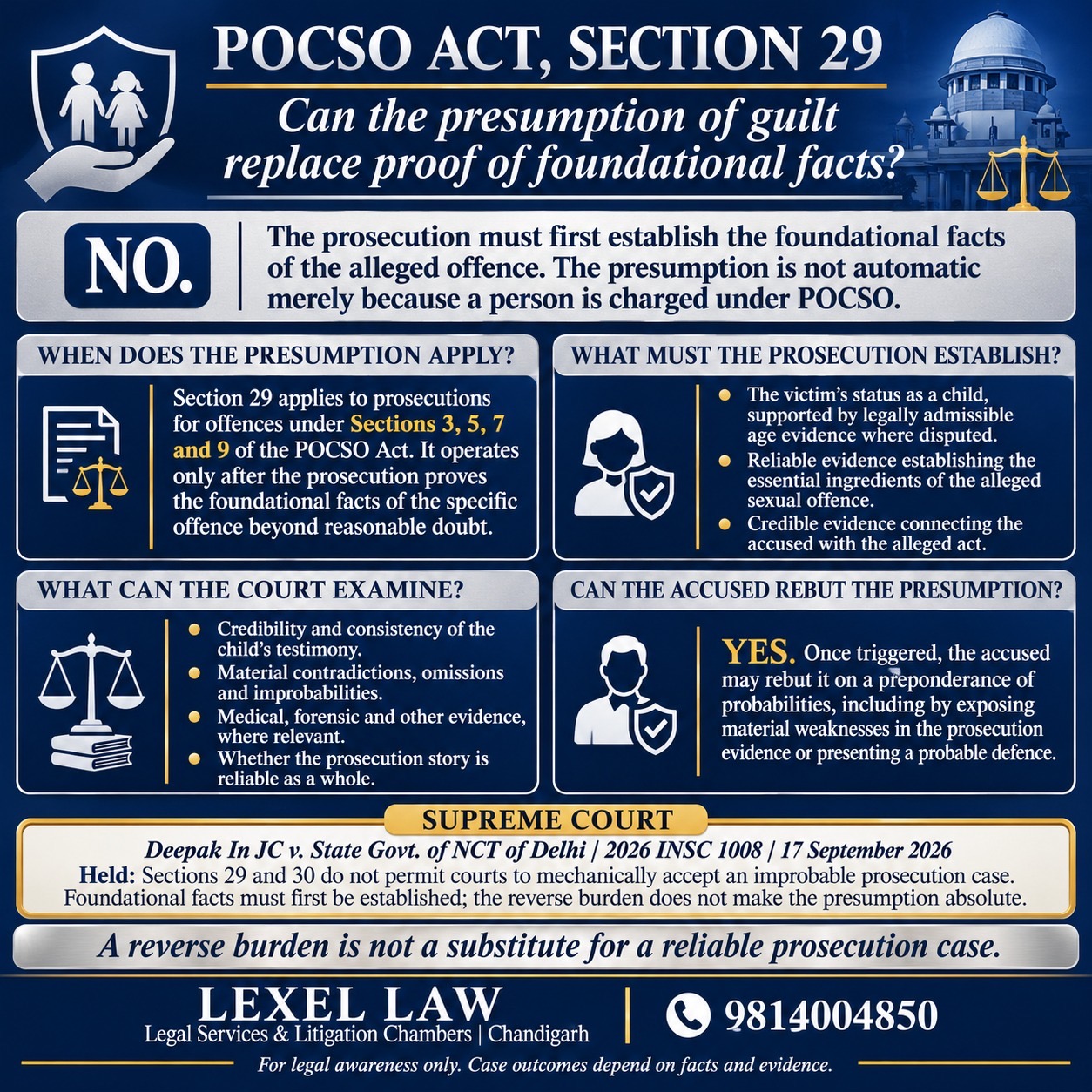
SECTION 29 OF THE POCSO ACT Can the Presumption of Guilt Substitute Proof of Foundational Facts? Understanding the Reverse Burden of Proof, Foundational Facts and the Supreme Court's Latest Position Introduction The Protection of Children from Sexual Offences Act, 2012 (POCSO Act) was enacted to protect children from sexual assault, sexual harassment and exploitation. Recognising the seriousness and sensitive nature of such offences, Parliament incorporated special evidentiary provisions to strengthen the prosecution of offences against children. One of the most significant provisions is Section 29 of the POCSO Act, which creates a statutory presumption against an accused person prosecuted for specified offences under the legislation. However,...

Continue reading
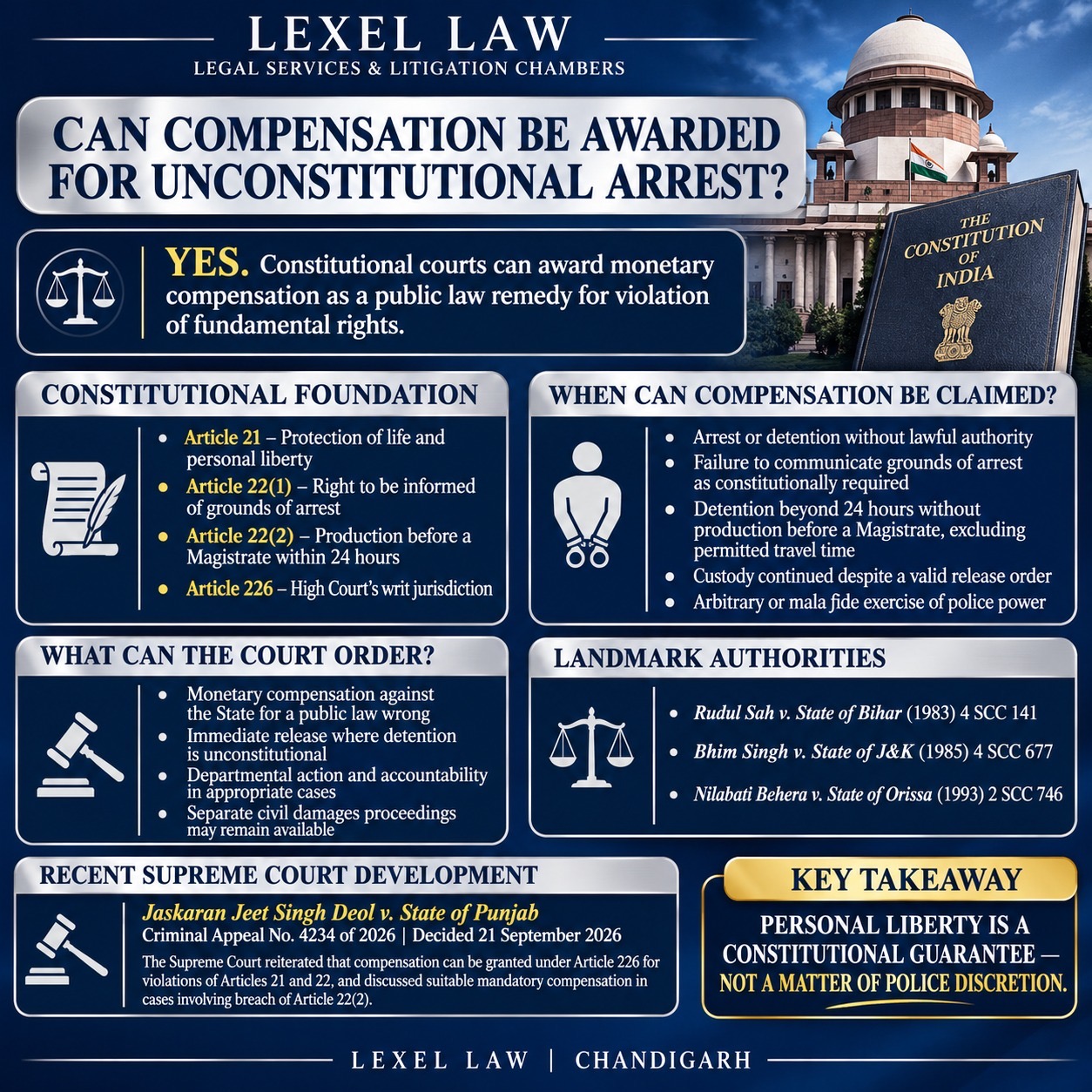
CAN COMPENSATION BE AWARDED FOR UNCONSTITUTIONAL ARREST?

Inforgraphic

CAN COMPENSATION BE AWARDED FOR UNCONSTITUTIONAL ARREST? Constitutional Remedies, Police Accountability and the Right to Personal Liberty Introduction The power of arrest is one of the most significant powers exercised by law enforcement authorities. However, this power is not absolute and must operate within the constitutional framework of India. An arrest that disregards established legal procedures, violates fundamental rights or results in unlawful detention may amount to an infringement of the constitutional guarantee of personal liberty. The Constitution of India recognises the right to life and personal liberty under Article 21 and provides specific safeguards against arbitrary arrest and detention under Article 22. These...

Continue reading

Bail Conditions & Constitutional Liberty: How Far Can Courts Go?

Bail Conditions & Constitutional Liberty: How Far Can Courts Go? Introduction Bail is fundamentally concerned with balancing two competing considerations: the individual’s right to personal liberty and the legitimate interests of the criminal justice system. While a court may impose conditions while granting bail, the power to impose such conditions is not unlimited. The question becomes particularly significant when a bail condition affects an accused person’s residence, movement, property, employment, travel or other constitutionally protected interests. Two significant Supreme Court decisions in 2026 — Feroze Basha & Anr. v. State of Tamil Nadu and Sachin Yadav v. State (NCT of Delhi) & Anr. —...

Continue reading

Marital Rape Exception Under The BNS : Can Criminal Law Exclude Non-Consensual Sex Within Marriage?

MARITAL RAPE EXCEPTION UNDER THE BNS Can Criminal Law Exclude Non-Consensual Sex Within Marriage? Constitutional Validity • Consent • Bodily Autonomy • Gender Justice   LATEST SUPREME COURT UPDATE The constitutional question remains pending. In September 2026, the Supreme Court agreed to examine the constitutional validity of the marital-rape exception under the erstwhile Indian Penal Code (IPC) and the corresponding provision under the Bharatiya Nyaya Sanhita, 2023 (BNS). The proceedings raise fundamental questions concerning Article 14, Article 21, dignity, privacy, bodily autonomy, consent and the constitutional status of marriage. Important: The Supreme Court has not, as of this publication, delivered a final judgment striking down or upholding the...

Continue reading

Can a High Court Order a CBI Investigation Without the State Government’s Consent?

Can a High Court Order a CBI Investigation Without the State Government’s Consent? Constitutional Law | Criminal Investigation | Federalism Introduction The power of a High Court to direct an investigation by the Central Bureau of Investigation (CBI) raises an important constitutional question: can a State Government’s objection prevent a constitutional court from ordering an independent probe? The answer, under established Supreme Court authority, is no—not in every case. Although the Delhi Special Police Establishment Act, 1946 ordinarily requires State consent for the CBI to exercise its police powers within a State, that statutory framework does not curtail the constitutional jurisdiction of the...

Continue reading

Frozen Bank Accounts, Frozen Rights: How Far Can Police Go Under the BNSS?

Frozen Bank Accounts, Frozen Rights: How Far Can Police Go Under the BNSS? Police Powers, Proportionality and the Emerging Judicial Safeguards in Cybercrime Investigations The rapid growth of digital payments, online banking and cybercrime has created a difficult legal question: how far can investigating agencies go when they seek to freeze a bank account allegedly connected with a criminal transaction? For victims of cyber fraud, immediate preservation of suspected funds can be crucial. Money can move through multiple bank accounts within minutes, making prompt investigative action important. At the same time, an indiscriminate debit-freeze can completely disable an innocent person’s savings account or...

Continue reading

Builder–Buyer Disputes: What Can Homebuyers Do When Builders Fail to Deliver?

Builder–Buyer Disputes: What Can Homebuyers Do When Builders Fail to Deliver? Homebuyers Are Not Without Remedies Buying a home is often one of the largest financial commitments made by an individual or family. However, disputes frequently arise when developers fail to deliver possession within the promised period, demand amounts beyond the agreed consideration, alter the specifications of the project, delay execution of conveyance documents, or fail to provide promised amenities. The legal framework governing real-estate transactions in India provides several remedies to affected homebuyers. The Real Estate (Regulation and Development) Act, 2016 (RERA) was enacted with the objective of regulating the real-estate sector...

Continue reading

Front-of-Pack Warning Labels in India: Food Safety, Public Health and Corporate Responsibility

Front-of-Pack Warning Labels in India: Food Safety, Public Health and Corporate Responsibility Should India Mandate Clear Warning Labels on Packaged Foods? Food packaging is no longer merely a means of identifying a product. For consumers, the information displayed on a package can influence purchasing decisions, dietary choices and, ultimately, public health. This has brought the issue of Front-of-Pack Labelling (FoPL) into the centre of India’s regulatory and constitutional debate. The controversy has acquired particular significance following the intervention of the Supreme Court of India in 3S and Our Health Society v. Union of India & Anr., W.P. (C) No. 437 of 2024. The proceedings...

Continue reading

Can a Company Be Criminally Prosecuted Without Any Director Being an Accused?

Can a Company Be Criminally Prosecuted Without Any Director Being an Accused? Supreme Court Clarifies the Scope of Corporate Criminal Liability Can a company be prosecuted for a criminal offence when no director, employee, officer or other natural person has been arraigned as an accused? The answer is yes, in appropriate cases. The Supreme Court of India has recently provided important clarity on this question in Sanofi India Ltd. v. Central Bureau of Investigation, 2026 INSC 957, decided on 7 September 2026. The judgment examines corporate criminal liability, attribution of acts and mens rea to companies, and the circumstances in which the absence of an...

Continue reading

A Well-Drafted Contract Is Your First Line of Legal Protection

A Well-Drafted Contract Is Your First Line of Legal Protection Why Clear Contract Drafting Matters in Business and Commercial Relationships A contract is much more than a document recording an agreement between two or more parties. It is a legal framework that defines the rights, responsibilities, expectations and remedies of the parties throughout their relationship. Whether it is a business agreement, employment contract, service agreement, lease, vendor arrangement, partnership agreement, technology contract or commercial transaction, the quality of the drafting can significantly influence how effectively the parties can protect their interests. Many contractual disputes do not arise because the parties deliberately intended to breach...

Continue reading