



CAN COMPENSATION BE AWARDED FOR UNCONSTITUTIONAL ARREST?
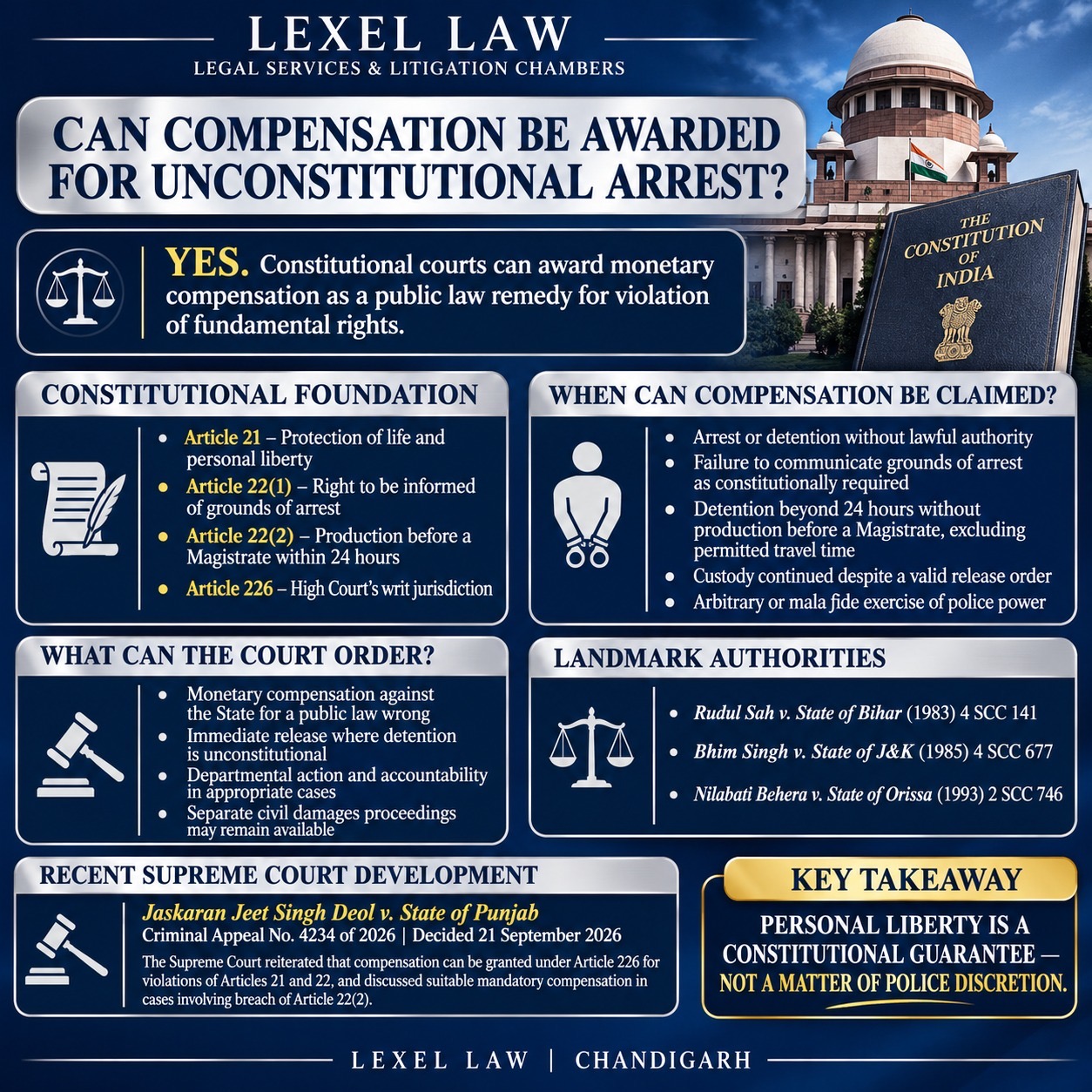
CAN COMPENSATION BE AWARDED FOR UNCONSTITUTIONAL ARREST?
Constitutional Remedies, Police Accountability and the Right to Personal Liberty
Introduction
The power of arrest is one of the most significant powers exercised by law enforcement authorities. However, this power is not absolute and must operate within the constitutional framework of India. An arrest that disregards established legal procedures, violates fundamental rights or results in unlawful detention may amount to an infringement of the constitutional guarantee of personal liberty.
The Constitution of India recognises the right to life and personal liberty under Article 21 and provides specific safeguards against arbitrary arrest and detention under Article 22. These provisions impose a constitutional obligation upon the State and its instrumentalities to ensure that no individual is deprived of liberty except in accordance with law.
An important question consequently arises: when a person is unlawfully arrested or detained in violation of constitutional safeguards, is release from custody the only remedy, or can the individual also claim monetary compensation from the State? The Supreme Court of India has consistently recognised that monetary compensation may be awarded in appropriate cases as a public law remedy for established violations of fundamental rights.
1. Constitutional Framework: Articles 21 and 22
Article 21 – Protection of Life and Personal Liberty
Article 21 provides: “No person shall be deprived of his life or personal liberty except according to procedure established by law.”
The expression “personal liberty” has been interpreted broadly by the Supreme Court. It protects individuals against arbitrary State action and requires that any deprivation of liberty must satisfy constitutional and legal requirements. An arrest undertaken without lawful authority, detention without proper judicial authorisation or continued custody despite the absence of legal justification may attract constitutional scrutiny under Article 21.
Article 22 – Protection Against Arbitrary Arrest and Detention
Article 22 provides additional safeguards to persons who are arrested. Article 22(1) requires that an arrested person be informed, as soon as may be, of the grounds of arrest and not be denied the right to consult and be defended by a legal practitioner of their choice. Article 22(2) requires production before the nearest Magistrate within 24 hours of arrest, excluding the time necessary for the journey. Detention beyond this period requires the authority of a Magistrate.
Under the Bharatiya Nagarik Suraksha Sanhita, 2023 (BNSS), Sections 47 and 58 correspond to important statutory protections concerning communication of grounds of arrest and production before a Magistrate within the prescribed period.
2. Can a Constitutional Court Award Monetary Compensation?
The answer is yes. The Supreme Court and High Courts can award monetary compensation in appropriate cases where a violation of fundamental rights is established. The constitutional jurisdiction under Article 32, exercised by the Supreme Court, and Article 226, exercised by High Courts, is not restricted to issuing directions for release or declaring State action unlawful.
In appropriate circumstances, constitutional courts may grant monetary relief to the victim for the violation of fundamental rights. This remedy is commonly described as constitutional compensation or public law compensation.
It is important to distinguish this remedy from an ordinary civil claim for damages. Public law compensation addresses the violation of a constitutional obligation by the State, whereas a civil action may independently determine liability and damages under private law principles. The availability of constitutional compensation does not automatically establish personal civil or criminal liability against every police officer involved. Such liability must be determined in accordance with the applicable legal proceedings.
3. Landmark Supreme Court Judgments
A. Rudul Sah v. State of Bihar (1983) 4 SCC 141
This judgment is one of the foundational authorities recognising compensation for unlawful detention. The petitioner had been acquitted by the Sessions Court in 1968 but continued to remain imprisoned until 1982, approximately fourteen years after his acquittal.
The Supreme Court held that merely directing the release of an individual would not adequately remedy such a serious infringement of personal liberty. It recognised that monetary compensation could be awarded under Article 32 for the violation of Article 21.
Legal significance: The judgment established that constitutional courts can award monetary compensation for unlawful deprivation of personal liberty. Release from illegal detention need not be the only remedy available to the victim.
B. Bhim Singh v. State of Jammu & Kashmir (1985) 4 SCC 677
Bhim Singh, a Member of the Legislative Assembly, was unlawfully arrested and prevented from attending the legislative session. By the time the matter was considered by the Supreme Court, he had already been released.
Nevertheless, the Court recognised that his release did not erase the constitutional violation and awarded compensation of ₹50,000 for the infringement of his fundamental rights.
Legal significance: Compensation can be awarded even after the victim has been released. An unlawful arrest cannot be retrospectively justified merely because the individual is no longer in custody.
C. Nilabati Behera v. State of Orissa (1993) 2 SCC 746
This case concerned the death of the petitioner’s son while he was in police custody. The Supreme Court recognised the responsibility of the State to protect the fundamental rights of individuals in its custody.
The Court clarified that compensation under Articles 32 and 226 is a public law remedy founded upon the State’s constitutional responsibility. It further recognised that the defence of sovereign immunity cannot be invoked to defeat a claim for public law compensation arising from an established violation of fundamental rights.
Legal significance: The judgment clarified the independent nature of constitutional compensation and established that such relief may coexist with remedies available under ordinary civil and criminal law.
D. Sube Singh v. State of Haryana (2006) 3 SCC 178
This judgment is particularly important because it explains the circumstances in which constitutional compensation should be granted. The Supreme Court emphasised that compensation is not automatic whenever an allegation of illegal detention or custodial misconduct is made.
The Court identified important considerations, including whether the violation of Article 21 is patent and incontrovertible; whether it is gross and of such magnitude that it shocks the conscience of the Court; and whether alleged custodial torture or violation is supported by medical evidence, visible injuries or other reliable material.
Legal significance: The judgment establishes an important threshold for granting monetary compensation and prevents constitutional writ jurisdiction from becoming an automatic substitute for a civil trial.
4. Recent Supreme Court Development: Jaskaran Jeet Singh Deol v. State of Punjab (2026 INSC 1022)
A significant development in this area emerged from the Supreme Court judgment dated 21 September 2026 in Jaskaran Jeet Singh Deol v. State of Punjab, Criminal Appeal No. 4234 of 2026.
The case arose from proceedings involving alleged violations of Articles 22(1) and 22(2) of the Constitution. The appellant was arrested in Punjab on 17 May 2026 but was produced before the Magistrate beyond the constitutionally prescribed period of 24 hours. Additionally, written grounds of arrest had not been furnished to him.
The Magistrate directed his release on account of non-compliance with the constitutional requirement concerning communication of grounds of arrest. The matter subsequently reached the Supreme Court, which examined the consequences of violating constitutional safeguards and the procedure required if the investigating agency sought his custody again.
The Supreme Court reiterated that the requirement to communicate written grounds of arrest is a mandatory constitutional safeguard. It also examined the consequences of failure to produce an arrested person before a Magistrate within 24 hours.
Importantly, in paragraph 36 of the judgment, the Court held that where there is a breach of Article 22(2), the High Court may, depending upon the facts and circumstances, direct payment of compensation as part of the public law remedy. The Court also preserved the individual’s right to pursue a remedy under private civil law.
Why is this judgment important? It reinforces that the constitutional consequences of unlawful detention are not necessarily exhausted by release from custody. Depending on the facts, monetary compensation may also be appropriate.
5. Public Law Compensation Versus Private Law Damages
An important distinction must be maintained between compensation awarded under constitutional jurisdiction and damages claimed through an ordinary civil action.
Public law compensation is granted under Articles 32 and 226 to remedy an established violation of fundamental rights. Its primary purpose is to provide monetary redress for a constitutional wrong and reinforce accountability of State authorities.
Private law damages may be claimed through a civil suit based on established principles of tort law, including wrongful confinement, false imprisonment, negligence or other actionable misconduct.
The two remedies are not necessarily mutually exclusive. In Nilabati Behera v. State of Orissa, the Supreme Court recognised that an award of compensation under public law does not prevent an aggrieved person from pursuing an independent civil action for damages or criminal proceedings against responsible individuals.
6. What Factors Should Courts Consider Before Awarding Compensation?
Although constitutional compensation is recognised, it is not granted automatically in every case involving an irregularity in arrest. Courts generally examine the nature, seriousness and evidentiary foundation of the alleged constitutional violation.
- Nature of the violation: Whether the arrest or detention involved a clear infringement of Articles 21 or 22.
- Duration of unlawful detention: Whether the individual remained in custody without lawful authority and for how long.
- Conduct of police authorities: Whether the violation resulted from a bona fide mistake, gross negligence, deliberate misconduct or arbitrary exercise of power.
- Supporting evidence: Whether official arrest records, remand orders, medical reports, CCTV footage, custody registers and other material establish the violation.
- Consequences suffered: Whether the individual experienced physical injury, mental suffering, reputational damage or other serious consequences.
The principles in Sube Singh v. State of Haryana remain particularly relevant when determining whether a violation meets the threshold for constitutional monetary relief.
7. Remedies Available to a Victim of Unconstitutional Arrest
A. Writ Petition under Article 226
A person may approach the jurisdictional High Court seeking appropriate constitutional relief, including a declaration of unlawful detention and, in suitable cases, monetary compensation.
B. Petition under Article 32
Where a fundamental right has been violated, the individual may approach the Supreme Court under Article 32 for enforcement of constitutional rights.
C. Departmental Proceedings
Where police misconduct is established, appropriate disciplinary proceedings may be initiated against the responsible officers in accordance with applicable service rules.
D. Criminal Proceedings
Where the conduct of police personnel discloses a criminal offence, appropriate criminal proceedings may be initiated in accordance with law.
E. Civil Action for Damages
The victim may independently consider a civil claim for damages against the State or other legally responsible persons, subject to the applicable law and requirements of proof.
These remedies serve different purposes and their availability will depend upon the facts of the individual case.
8. Implications for Criminal Litigation in Punjab and Haryana
The judgment in Jaskaran Jeet Singh Deol v. State of Punjab carries particular importance for criminal litigation before the Punjab and Haryana High Court. It reinforces the need for strict compliance with constitutional safeguards at every stage of arrest and detention.
For defence counsel, the judgment provides an important basis for examining:
- Whether written grounds of arrest were communicated in accordance with Article 22(1) and Section 47 BNSS.
- Whether the arrested person was produced before the Magistrate within the period prescribed under Article 22(2) and Section 58 BNSS.
- Whether remand proceedings were conducted in accordance with constitutional requirements.
- Whether continued detention was supported by lawful judicial authority.
- Whether the facts justify seeking monetary compensation under Article 226.
The judgment also highlights the importance of judicial oversight where investigating agencies seek further custody following release arising from a constitutional violation. Importantly, the seriousness of the alleged offence does not dilute the constitutional safeguards available to an arrested person.
Conclusion
The constitutional protection of personal liberty would remain incomplete if an individual subjected to unlawful arrest or detention could obtain nothing more than an order of release.
The Supreme Court, through decisions such as Rudul Sah, Bhim Singh, Nilabati Behera and Sube Singh, has developed a framework recognising monetary compensation as an appropriate public law remedy in cases involving established violations of fundamental rights.
The recent judgment in Jaskaran Jeet Singh Deol v. State of Punjab further reinforces this constitutional framework by expressly recognising the possibility of compensation for violations of Article 22(2), depending upon the facts and circumstances of the case.
Ultimately, the power of arrest must always remain subject to constitutional accountability. The State cannot claim unrestricted authority over an individual’s liberty, and procedural safeguards cannot be treated as dispensable formalities.
PERSONAL LIBERTY IS A CONSTITUTIONAL GUARANTEE, AND ITS VIOLATION MUST HAVE MEANINGFUL LEGAL CONSEQUENCES.
References and Legal Authorities
- Rudul Sah v. State of Bihar, (1983) 4 SCC 141.
- Bhim Singh v. State of Jammu & Kashmir, (1985) 4 SCC 677.
- Nilabati Behera v. State of Orissa, (1993) 2 SCC 746.
- Sube Singh v. State of Haryana, (2006) 3 SCC 178.
- Jaskaran Jeet Singh Deol v. State of Punjab, Criminal Appeal No. 4234 of 2026, 2026 INSC 1022, decided on 21 September 2026.
- Constitution of India – Articles 21, 22, 32 and 226.
- Bharatiya Nagarik Suraksha Sanhita, 2023 – Sections 47 and 58.
Disclaimer: This article is intended for legal awareness and academic discussion. The availability of compensation depends upon the facts, evidence and applicable legal principles in each case.
LEXEL LAW
Legal Services & Litigation Chambers | Chandigarh
Contact: 9814004850