



Effect of default committed by one party while claiming Input Tax Credit in GST
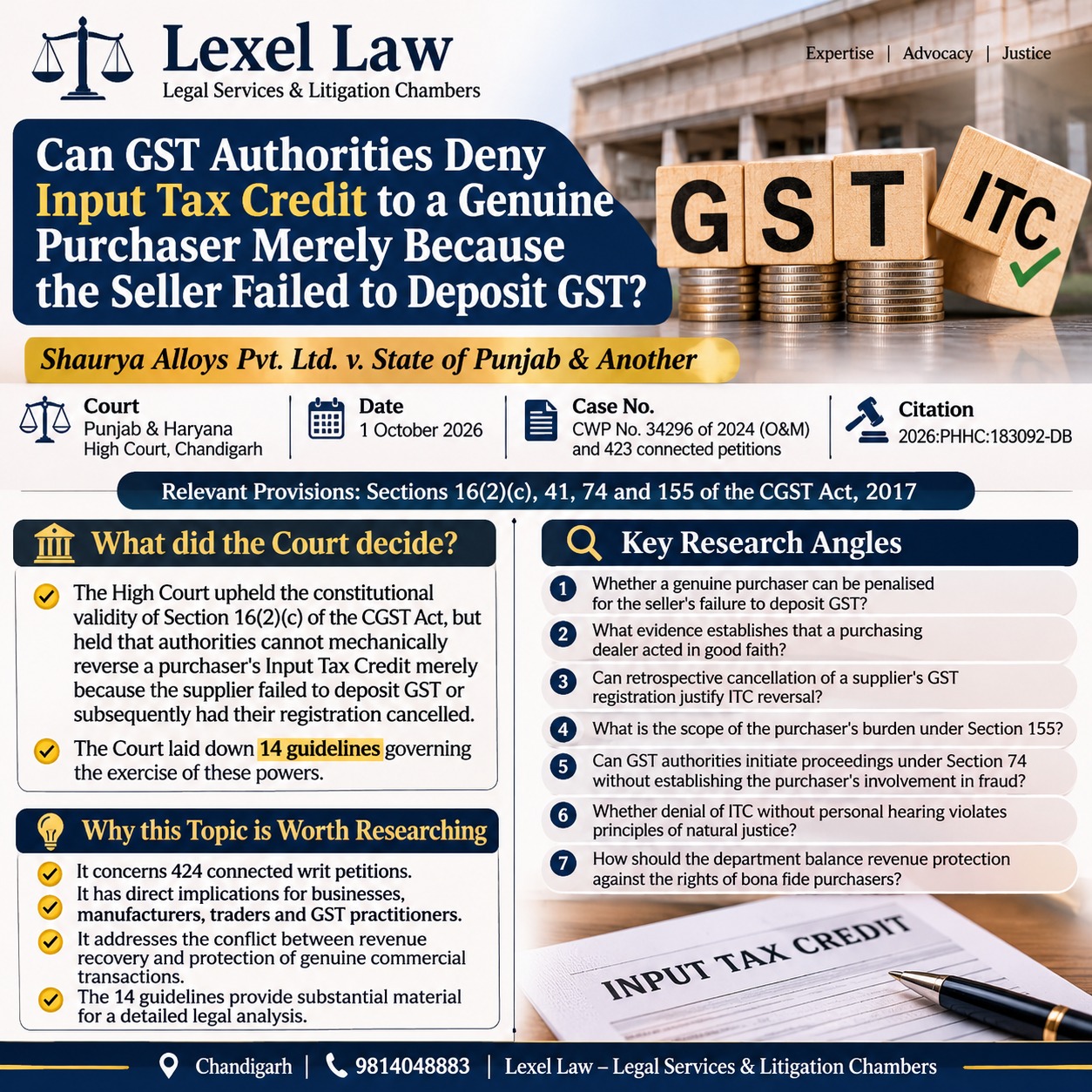
Can GST Authorities Deny Input Tax Credit to a Genuine Purchaser Merely Because the Seller Failed to Deposit GST?
A Legal Analysis of Shaurya Alloys Pvt. Ltd. v. State of Punjab & Another
Court: Punjab & Haryana High Court, Chandigarh
Date of Judgment: 1 October 2026
Case Number: CWP No. 34296 of 2024 and connected matters
Citation: 2026:PHHC:183092-DB
Relevant Provisions: Sections 16(2)(c), 41, 74, 75, 76 and 155 of the Central Goods and Services Tax Act, 2017.
1. Introduction
Input Tax Credit (ITC) is one of the fundamental features of India’s Goods and Services Tax framework. It enables registered businesses to claim credit for tax paid on purchases used in the course or furtherance of business, thereby reducing the cascading effect of taxation. However, disputes frequently arise when a supplier collects GST from a purchaser but subsequently fails to deposit the corresponding tax with the Government.
An important legal question consequently emerges: should a genuine purchaser lose the benefit of Input Tax Credit because of a default committed by the selling dealer, despite having paid the invoice value, including GST, and received the goods or services?
The Punjab and Haryana High Court examined this issue in Shaurya Alloys Pvt. Ltd. v. State of Punjab & Another, delivering an important judgment on 1 October 2026. The decision addresses the constitutional validity of Section 16(2)(c) of the CGST Act and establishes safeguards governing the manner in which GST authorities may deny or reverse ITC.
2. Statutory Framework Governing Input Tax Credit
Section 16 of the CGST Act, 2017, provides the statutory framework for claiming Input Tax Credit. While Section 16(1) recognises the entitlement of registered persons to claim credit on eligible business purchases, Section 16(2) prescribes conditions that must be satisfied before such credit can be availed.
These conditions broadly include possession of a valid tax invoice or debit note, receipt of goods or services, furnishing of relevant invoice details by the supplier, and actual payment of the tax charged to the Government, subject to the statutory scheme.
Section 16(2)(c) specifically requires that the tax charged in respect of a supply must have been actually paid to the Government, either in cash or through utilisation of admissible Input Tax Credit.
Section 155 places the burden of proving eligibility for Input Tax Credit upon the person claiming such credit.
The controversy arises because a purchaser may possess invoices, banking records, e-way bills and evidence of actual receipt of goods but may have no direct control over whether the supplier subsequently deposits the collected tax.
3. Background of the Shaurya Alloys Judgment
In Shaurya Alloys Pvt. Ltd., the High Court considered a substantial batch of writ petitions involving disputes concerning denial or reversal of Input Tax Credit under Section 16(2)(c).
The purchasing dealers challenged departmental actions in which ITC had been questioned or reversed because suppliers had failed to deposit tax, reflected nil or short tax liability in their returns, or had subsequently faced cancellation of GST registration, including retrospective cancellation.
The petitioners argued that a genuine purchaser should not automatically suffer the consequences of a supplier’s independent statutory default. They contended that the purchaser could not reasonably be expected to exercise control over the supplier’s tax compliance after completing a genuine commercial transaction.
The Revenue, on the other hand, emphasised that actual payment of tax to the Government remains a statutory condition for claiming ITC.
The Court therefore had to balance the statutory conditions governing ITC against the procedural protections available to genuine purchasing dealers.
4. Constitutional Validity of Section 16(2)(c)
One of the central issues before the High Court was whether Section 16(2)(c) of the CGST Act violated constitutional guarantees, including Articles 14 and 19(1)(g), by imposing consequences upon purchasers for defaults committed by suppliers.
The petitioners relied upon the principle of lex non cogit ad impossibilia, meaning that the law does not compel a person to perform an impossible act.
They argued that a purchaser cannot independently guarantee that a supplier will deposit the tax collected from the purchaser into the Government treasury.
However, the High Court declined to declare Section 16(2)(c) unconstitutional or read it down so as to restrict its operation exclusively to cases involving fraud, collusion or fictitious transactions.
The Court recognised that actual payment of tax is an essential statutory condition underlying the availability of ITC.
Importantly, the Court distinguished between the validity of the statutory provision and the manner in which departmental authorities exercise their powers under it.
It held that the constitutional validity of Section 16(2)(c) does not authorise GST authorities to invoke the provision mechanically without examining the surrounding circumstances and the statutory safeguards.
5. Mechanical Reversal of ITC: The Court’s Important Clarification
A significant aspect of the judgment is the Court’s observation that Section 16(2)(c), read with Section 155, cannot be treated as an isolated provision to automatically impose liability upon a purchasing dealer whenever the selling dealer fails to deposit tax.
Before reversing ITC, the proper officer must examine the circumstances surrounding the supplier’s default, the genuineness of the transaction and the recovery mechanisms available against the defaulting supplier.
The Court also recognised that retrospective cancellation of a supplier’s registration cannot, by itself, establish that every transaction undertaken with that supplier was fictitious or ineligible.
The Department must examine whether the grounds for cancellation have any connection with the particular supply in question.
This interpretation is particularly significant for businesses that maintain genuine commercial transactions but subsequently face departmental proceedings because of supplier-related irregularities.
6. The Role of Section 155 and the Purchaser’s Burden of Proof
Section 155 continues to place the burden of establishing ITC eligibility upon the purchasing dealer. The judgment does not eliminate this statutory responsibility.
A purchaser claiming ITC must be prepared to establish the genuineness of the transaction through reliable documentary evidence.
Relevant documents may include:
Valid tax invoices and debit notes.
Proof of payment through banking channels.
E-way bills and transportation documents.
Goods receipt notes and delivery acknowledgements.
Weighbridge slips and vehicle movement records.
Stock registers and consumption records.
Relevant purchase orders and business correspondence.
The Court emphasised that such material must be considered by the proper officer while determining eligibility for ITC.
Consequently, maintaining proper commercial documentation is not merely an accounting requirement; it is also an important legal safeguard during GST proceedings.
7. Section 74 and the Requirement to Establish Fraud
Another important aspect concerns proceedings initiated under Section 74 of the CGST Act on allegations of fraud, wilful misstatement or suppression of facts.
The High Court relied upon the principles discussed in M/s G.R. Infra Projects Limited Ratlam and M/s Tata Steel Limited v. Union of India, 2026 INSC 920, concerning the requirement that foundational facts supporting allegations of fraud must appear in the show cause notice itself.
The Court clarified that the fraud committed by a supplier cannot automatically be attributed to the purchasing dealer.
The notice must disclose facts connecting the purchasing dealer with the alleged fraudulent conduct.
A mere reference to fraud, suppression or wilful misstatement without explaining the factual basis for such allegations is insufficient.
This approach reinforces the principle that extended limitation and fraud-based proceedings must be supported by proper application of mind.
8. Fourteen Guidelines Issued by the High Court
To prevent routine and mechanical invocation of Section 16(2)(c), the High Court laid down fourteen guidelines for GST authorities.
The important principles include:
Supplier registration cancellation or nil tax liability cannot independently justify ITC reversal.
Authorities must examine the supplier’s default and relevant tax periods.
Investigation must establish a direct link between the purchaser and the supplier.
Show cause notices must disclose relevant particulars and supporting material.
Fraud allegations under Section 74 must contain foundational facts.
Purchasers may establish eligibility through invoices, transport records and evidence of receipt.
Retrospective registration cancellation requires examination of its grounds and relevance to the transaction.
Recovery proceedings against the supplier must be considered.
The statutory framework applicable during the relevant tax period must be followed.
A purchaser’s registration cannot automatically be cancelled because the supplier’s registration was cancelled.
Personal hearing must be provided in accordance with Section 75(4).
Adjudication orders must contain reasons and findings on disputed statutory conditions.
Depositing an amount during investigation does not automatically cure deficiencies in the show cause notice.
The guidelines apply to pending proceedings and proceedings initiated subsequently.
These directions seek to ensure that the statutory conditions for ITC are enforced through a fair and legally sustainable process.
9. Practical Implications for Businesses and Taxpayers
The judgment has considerable significance for manufacturers, traders, wholesalers and businesses operating under the GST regime.
Purchasers facing ITC reversal proceedings should carefully preserve documentary evidence demonstrating the genuineness of their transactions.
Businesses should regularly verify supplier GST registrations, reconcile purchase invoices with GST portal records and maintain appropriate transportation and payment documentation.
Where a supplier defaults, the purchaser should examine the precise grounds of the proposed ITC reversal and determine whether the Department has complied with the procedural safeguards identified by the High Court.
The judgment also provides an important basis for challenging proceedings founded exclusively upon retrospective registration cancellation or the supplier’s failure to deposit tax.
However, it must be remembered that the judgment does not create an unconditional right to ITC. Transactions involving fraud, collusion, absence of actual supply or failure to satisfy statutory eligibility conditions may still attract reversal in accordance with law.
10. Conclusion
The decision in Shaurya Alloys Pvt. Ltd. v. State of Punjab & Another represents an important development in GST jurisprudence. By upholding Section 16(2)(c) while restricting its mechanical application, the Punjab and Haryana High Court has emphasised the importance of balancing statutory tax compliance with procedural fairness.
The judgment reinforces that genuine commercial transactions must be examined on their own facts and that a supplier’s default cannot automatically establish wrongdoing on the part of the purchaser.
For businesses and tax practitioners, the fourteen guidelines provide an important framework for examining ITC disputes, challenging arbitrary reversals and ensuring compliance with statutory safeguards.
Ultimately, the decision reiterates that GST enforcement must protect Government revenue without disregarding the rights of genuine taxpayers or compromising the principles of natural justice.
LEXEL LAW – LEGAL SERVICES & LITIGATION CHAMBERS
Legal Research | Tax Litigation | Commercial Disputes | Civil & Criminal Litigation
Chandigarh
Disclaimer: This article is intended for general legal awareness and academic discussion. It does not constitute legal advice. The applicability of the judgment depends upon the relevant facts, tax period and statutory provisions.