



Section 29 Of The POCSO Act – Can the Presumption of Guilt Substitute Proof of Foundational Facts?
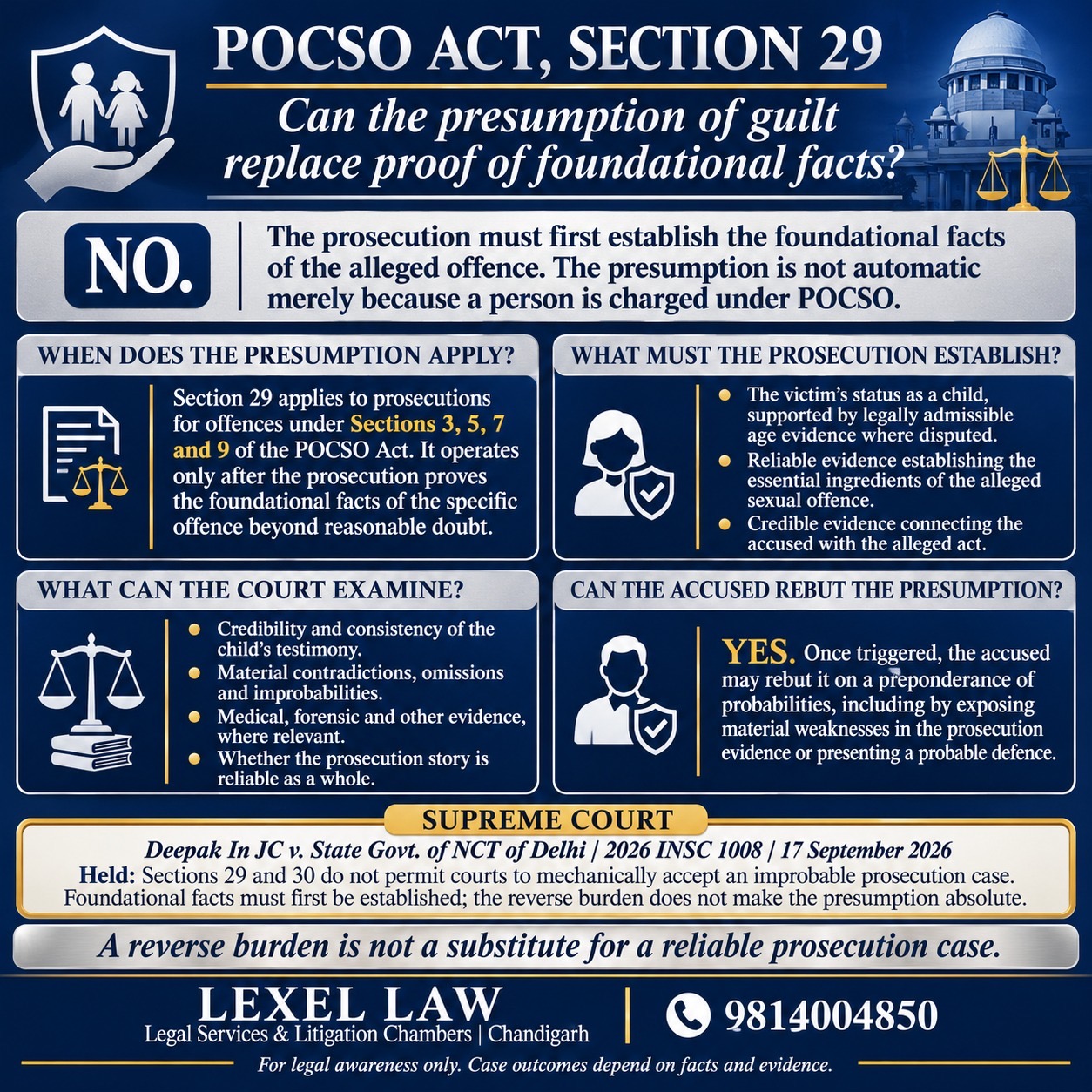
SECTION 29 OF THE POCSO ACT
Can the Presumption of Guilt Substitute Proof of Foundational Facts?
Understanding the Reverse Burden of Proof, Foundational Facts and the Supreme Court’s Latest Position
Introduction
The Protection of Children from Sexual Offences Act, 2012 (POCSO Act) was enacted to protect children from sexual assault, sexual harassment and exploitation. Recognising the seriousness and sensitive nature of such offences, Parliament incorporated special evidentiary provisions to strengthen the prosecution of offences against children.
One of the most significant provisions is Section 29 of the POCSO Act, which creates a statutory presumption against an accused person prosecuted for specified offences under the legislation.
However, this provision raises an important question of criminal jurisprudence: Can the prosecution rely upon the statutory presumption of guilt without first establishing the basic facts constituting the alleged offence?
The answer is no. Although Section 29 shifts the evidentiary burden onto the accused once its legal foundation has been established, it does not eliminate the prosecution’s initial obligation to establish the foundational facts. The presumption is rebuttable and cannot be treated as an automatic declaration of guilt.
The Supreme Court’s decision in Deepak In JC v. State Govt. of NCT of Delhi, 2026 INSC 1008, dated 17 September 2026, provides important clarification on this issue.
1. Understanding Section 29 of the POCSO Act
Section 29 of the POCSO Act deals with the presumption as to certain offences. It provides that where a person is prosecuted for committing, abetting or attempting to commit an offence under Sections 3, 5, 7 or 9 of the Act, the Special Court shall presume that such person has committed, abetted or attempted to commit the offence, unless the contrary is proved.
The provision creates a reverse burden of proof, departing from the ordinary criminal-law principle that an accused is presumed innocent until proven guilty.
Ordinarily, the prosecution bears the burden of establishing the guilt of an accused beyond reasonable doubt. Section 29 modifies the evidentiary position by requiring the accused to rebut the statutory presumption once the prosecution establishes the necessary foundational facts.
However, the existence of a reverse burden does not mean that the prosecution can merely register an FIR, file a charge sheet and expect the court to presume guilt.
The statutory presumption is conditional upon the establishment of foundational facts.
2. What Are Foundational Facts?
Foundational facts are the essential preliminary facts that the prosecution must establish before the statutory presumption under Section 29 can operate.
These facts must relate to the basic ingredients of the particular offence alleged against the accused.
Depending upon the nature of the charge, the prosecution may be required to establish:
- The victim’s status as a child under the POCSO Act.
- The occurrence of the essential act constituting the alleged sexual offence.
- The facts establishing the relevant ingredients of the offence under Sections 3, 5, 7 or 9.
- The connection of the accused with the alleged act, supported by legally admissible evidence.
The precise foundational facts will depend upon the particular offence and the evidence available in the case.
For example, where an accused is charged with penetrative sexual assault, the prosecution must establish the basic facts constituting the alleged act under Section 3. The presumption under Section 29 cannot be invoked merely because the charge has been framed under the POCSO Act.
The prosecution must first establish the foundation upon which the presumption can legally operate.
3. Supreme Court’s Latest Position: Deepak In JC v. State Govt. of NCT of Delhi
In Deepak In JC v. State Govt. of NCT of Delhi, 2026 INSC 1008, decided on 17 September 2026, the Supreme Court examined the scope and application of Sections 29 and 30 of the POCSO Act.
The appellant had been convicted under Section 363 of the Indian Penal Code and Section 6 of the POCSO Act. The conviction was upheld by the Delhi High Court, which relied upon the prosecution evidence and the statutory presumption under Section 29.
Before the Supreme Court, the appellant challenged the reliability of the prosecution’s case, highlighting material contradictions in witness testimony, inconsistencies in the medical evidence and deficiencies in the forensic evidence.
The defence also relied upon circumstances suggesting previous hostility between the complainant’s family and the accused.
The Supreme Court undertook an independent assessment of the evidence and examined whether the statutory presumption could sustain the conviction despite the deficiencies in the prosecution case.
Important observations of the Supreme Court
The Court clarified that the presumptions under Sections 29 and 30 are not absolute.
It emphasised that:
- The prosecution must establish the basic and foundational facts constituting the offence.
- The statutory presumption does not make the prosecution’s version automatically acceptable.
- Courts must independently evaluate the evidence and cannot mechanically rely upon the reverse burden.
- The accused can rebut the presumption by demonstrating contradictions, improbabilities and weaknesses in the prosecution case.
- The ultimate determination must be based upon the totality of evidence.
The Court further explained that the reverse burden under Section 29 is essentially a rule shifting the evidentiary burden. It does not alter the prosecution’s ultimate obligation to prove guilt beyond reasonable doubt.
Finding material inconsistencies in the prosecution evidence and a credible defence, the Supreme Court set aside the conviction and acquitted the appellant.
This judgment reinforces the principle that statutory presumptions cannot override the fundamental requirements of criminal justice.
4. How Can the Accused Rebut the Presumption Under Section 29?
Once the prosecution establishes the foundational facts and the statutory presumption becomes operative, the accused is required to rebut it.
However, the accused is not required to establish innocence beyond reasonable doubt.
The applicable standard is preponderance of probabilities.
The Supreme Court in Deepak In JC recognised several ways through which the presumption may be rebutted:
A. Material contradictions in witness statements
Material inconsistencies between the FIR, statements recorded during investigation and testimony before the trial court may weaken the prosecution’s case.
B. Inconsistencies in medical and forensic evidence
Where medical evidence or forensic findings materially contradict the prosecution’s version, the court must examine their evidentiary significance.
C. Improbabilities in the prosecution’s narrative
An accused may demonstrate that the prosecution’s account is inherently improbable or inconsistent with the surrounding circumstances.
D. Effective cross-examination
Cross-examination may expose material omissions, improvements, contradictions and inconsistencies in the testimony of prosecution witnesses.
E. A probable defence
The accused may rely upon defence evidence or circumstances emerging from the prosecution’s own evidence to establish a probable alternative explanation.
Importantly, the accused does not necessarily have to enter the witness box to rebut the presumption. The prosecution’s own evidence, when properly scrutinised, may itself provide material sufficient to raise a probable defence.
5. Distinction Between Section 29 and Section 30 of the POCSO Act
Sections 29 and 30 create separate statutory presumptions and should not be treated as interchangeable.
Section 29 creates a presumption concerning the commission, abetment or attempt to commit specified offences under Sections 3, 5, 7 and 9.
Section 30, on the other hand, deals with the presumption of a culpable mental state where an offence under the Act requires such a mental element.
Section 30 also contains a specific evidentiary requirement under sub-section (2), concerning the standard for proving the absence of such mental state.
The distinction is significant because the prosecution must establish the relevant foundational facts before relying upon the applicable statutory presumption.
The Supreme Court’s decision in Just Rights for Children Alliance v. S. Harish, 2024 INSC 716, also provides important guidance regarding foundational facts and the operation of statutory presumptions under Section 30, particularly in the context of offences under Section 15 of the POCSO Act.
Therefore, the scope of each presumption must be assessed independently, having regard to the particular statutory provision and the ingredients of the alleged offence.
6. Constitutional Safeguards and the Right to a Fair Trial
The reverse burden under Section 29 must operate consistently with the constitutional guarantee of a fair trial under Article 21 of the Constitution of India.
While the protection of children from sexual offences is an important legislative objective, the statutory framework cannot be interpreted in a manner that makes conviction automatic.
The judiciary has an obligation to ensure that:
- The prosecution establishes the foundational facts.
- The evidence is assessed objectively.
- The accused receives a meaningful opportunity to rebut the presumption.
- Material evidence supporting the defence is not disregarded.
- The ultimate finding of guilt is based on proof beyond reasonable doubt.
The Supreme Court in Deepak In JC reaffirmed that the existence of a reverse burden cannot justify a departure from the ordinary standards of criminal evidence.
A statutory presumption is an evidentiary mechanism, not a replacement for judicial scrutiny.
7. Practical Implications for Criminal Litigation
The interpretation of Section 29 has substantial implications for both prosecution and defence in POCSO trials.
For the prosecution, it becomes essential to identify and establish the foundational facts before invoking the statutory presumption. A charge sheet containing allegations alone cannot satisfy this requirement.
For the defence, the judgment provides an important framework for challenging the prosecution’s case through effective cross-examination, examination of medical and forensic evidence, identification of material contradictions and presentation of a probable defence.
For trial courts, the judgment reinforces the need to distinguish between the initial burden of the prosecution and the subsequent evidentiary burden placed upon the accused.
The court must first determine whether the foundational facts have been established. Only thereafter can the presumption under Section 29 be applied.
This approach ensures that the protective purpose of the POCSO Act is preserved without compromising the fundamental principles governing criminal trials.
Conclusion
Section 29 of the POCSO Act represents an important legislative departure from the ordinary presumption of innocence. However, its operation is neither unconditional nor absolute.
The prosecution must first establish the foundational facts constituting the alleged offence. Once this threshold is crossed, the statutory presumption operates and the accused may rebut it on the standard of preponderance of probabilities.
The Supreme Court’s decision in Deepak In JC v. State Govt. of NCT of Delhi, 2026 INSC 1008, reiterates that a reverse burden cannot become a substitute for reliable prosecution evidence.
The ultimate principle remains clear: The presumption under Section 29 may shift the evidentiary burden, but it cannot relieve the prosecution of its fundamental obligation to prove guilt beyond reasonable doubt.
At the intersection of child protection and criminal jurisprudence, the objective must remain the same: effective prosecution of offences against children while preserving the constitutional guarantees of a fair trial.
Disclaimer: This article is intended for general legal awareness and academic discussion. The application of statutory presumptions depends upon the facts, evidence and specific charges in each case.
LEXEL LAW
Legal Services & Litigation Chambers
Chandigarh | 9814048883