



Use of Electronic and Digital Records in criminal investigations
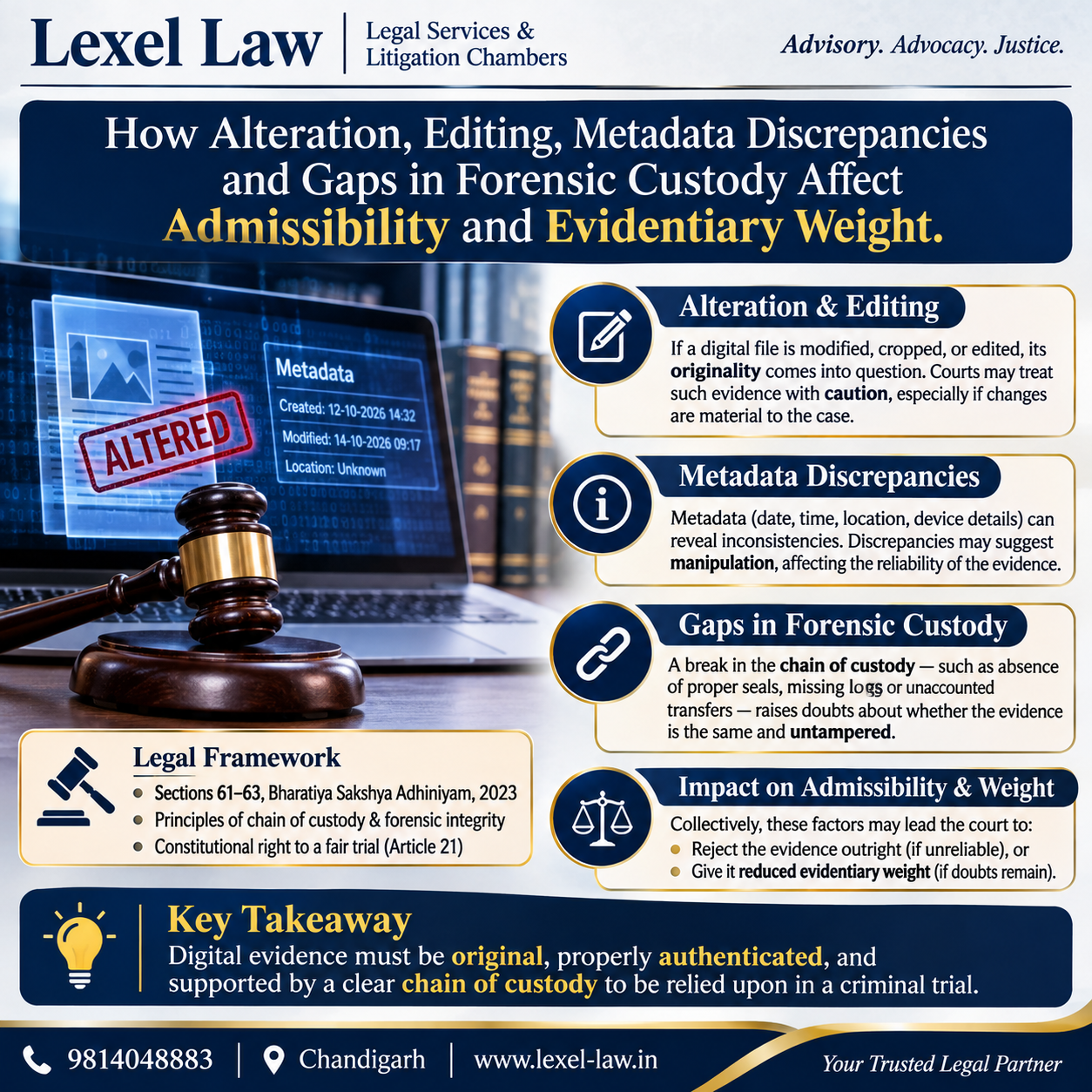
How Alteration, Editing, Metadata Discrepancies and Gaps in Forensic Custody Affect the Admissibility and Evidentiary Weight of Digital Evidence
Introduction
The increasing use of electronic and digital records in criminal investigations has significantly transformed the Indian criminal justice system. WhatsApp conversations, CCTV recordings, mobile phone data, call recordings, emails, location histories, photographs and computer-generated documents frequently form an important part of criminal prosecution. However, the growing dependence on electronic evidence has also created serious questions concerning its authenticity, integrity and reliability.
Unlike traditional documentary evidence, digital evidence can be modified, duplicated, edited or manipulated without leaving immediately visible signs. Even minor discrepancies in metadata, unexplained modifications or gaps in forensic custody may raise doubts about whether the electronic record produced before a court represents the original information.
The Bharatiya Sakshya Adhiniyam, 2023 (BSA), which came into force on 1 July 2024, recognises electronic and digital records as legally admissible evidence, subject to statutory requirements. Nevertheless, admissibility alone does not establish the truthfulness or reliability of the contents of an electronic record. The prosecution must still establish the evidentiary foundation necessary to enable the court to rely upon such material.
1. Legal Framework Governing Electronic Evidence in India
The primary statutory provisions governing electronic evidence are Sections 61, 62 and 63 of the Bharatiya Sakshya Adhiniyam, 2023.
Section 61 – Electronic or Digital Records
Section 61 provides that an electronic or digital record cannot be denied admissibility merely because it exists in electronic form. Subject to Section 63, such records have the same legal effect, validity and enforceability as other documents.
Section 62 – Special Provisions Relating to Electronic Records
Section 62 provides that the contents of electronic records may be proved in accordance with Section 63.
Section 63 – Admissibility of Electronic Records
Section 63 prescribes the conditions governing the admissibility of electronic records produced through computers and communication devices. These requirements include the regular use and proper functioning of the relevant device or system, the manner in which information was fed into the system, and the reproduction of information from the original electronic record.
Section 63(4) further requires a prescribed certificate identifying the electronic record, describing the manner of its production and providing relevant particulars of the device involved. The certificate is required to be signed by the appropriate person in charge or management representative and an expert, in accordance with the statutory provision.
These provisions demonstrate that the legislature intends electronic evidence to be supported by safeguards relating to its source, production and authenticity.
2. Alteration and Editing: The Problem of Digital Manipulation
One of the most significant challenges associated with electronic evidence is the possibility of alteration or manipulation.
Digital photographs can be cropped, audio recordings can be selectively edited, video footage can be rearranged, and screenshots of conversations can be created or modified using readily available software.
In criminal proceedings, such alterations may substantially affect the interpretation of evidence.
For instance, a CCTV recording presented by the prosecution may show only a particular portion of an incident. If the original footage is unavailable, or the investigating agency cannot explain whether the recording has been edited, questions may arise regarding the completeness and authenticity of the material.
Similarly, a WhatsApp conversation presented as a screenshot may omit preceding or subsequent messages that materially alter the meaning of the communication.
The court must therefore examine whether the electronic material represents an accurate and complete reproduction of the relevant information.
Not every modification necessarily makes digital evidence inadmissible. Legitimate technical processing, formatting or extraction may occur during forensic examination. However, unexplained or material alterations can undermine its reliability, particularly where the prosecution fails to establish the source file and the process through which the evidence was obtained.
3. Metadata Discrepancies and Their Evidentiary Significance
Metadata refers to information associated with a digital file that describes its characteristics and history.
Depending on the nature of the record, metadata may contain:
- Date and time of creation or modification.
- Device identification and technical information.
- File format and size.
- Location-related information, where available.
- Details concerning file transfers or processing.
Metadata can play an important role in establishing the origin and chronology of electronic evidence.
For example, where the prosecution alleges that a photograph was captured at a particular location and time, inconsistencies between the alleged occurrence and the available file information may require investigation.
Similarly, discrepancies between the timestamps of CCTV footage, mobile phone records and other electronic communications may create questions about the sequence of events.
However, metadata should not be treated as conclusive proof of authenticity. Device clocks may be incorrectly configured, time zones may differ, file transfers may modify certain attributes, and software may automatically alter metadata during processing.
The significance of a discrepancy must therefore be evaluated in its technical and factual context. Expert examination may be necessary to determine whether the inconsistency is attributable to ordinary system behaviour, technical processing or deliberate manipulation.
4. Breaks in the Forensic Chain of Custody
The chain of custody refers to the documented sequence through which electronic evidence is collected, preserved, transferred, examined and ultimately produced before the court.
Maintaining an uninterrupted and properly documented chain of custody is particularly important in criminal investigations because electronic evidence may be vulnerable to modification during handling.
Consider a situation where a mobile phone is seized from an accused person. The investigating agency subsequently sends the device for forensic examination, but the seizure records do not adequately document its condition, storage or transfer. The forensic report may identify certain messages or files, but the defence may question whether the device remained protected against unauthorised access or modification.
Important safeguards include:
- Proper seizure documentation and identification of the device.
- Recording the condition of the device at the time of seizure.
- Secure packaging and sealing, wherever appropriate.
- Maintaining records of every transfer and person handling the device.
- Creating forensic images using appropriate procedures.
- Recording hash values to verify the integrity of digital copies.
- Preserving original devices and source files wherever practicable.
A hash value is a digital fingerprint generated through a mathematical algorithm. Comparing hash values before and after transfer or examination can help establish whether a digital file or forensic image has changed.
However, a matching hash value does not independently prove that the original source material was genuine or that it had not already been manipulated before the hash was generated.
Consequently, forensic integrity requires a combination of technical verification, proper documentation and reliable evidence concerning the source of the material.
5. Judicial Approach: Authentication and Admissibility of Electronic Evidence
The Supreme Court of India has repeatedly emphasised the importance of safeguards governing electronic evidence.
Anvar P.V. v. P.K. Basheer (2014) 10 SCC 473
In this landmark judgment, the Supreme Court clarified the requirements governing the admissibility of secondary electronic evidence under Section 65B of the Indian Evidence Act, 1872.
The Court recognised that electronic records are particularly susceptible to tampering, alteration, transposition and excision. It emphasised the importance of establishing the source and authenticity of electronic records through the prescribed statutory procedure.
Arjun Panditrao Khotkar v. Kailash Kushanrao Gorantyal (2020) 7 SCC 1
The Supreme Court reaffirmed the mandatory nature of the Section 65B certificate requirement for computer-generated secondary electronic evidence under the earlier Evidence Act.
The judgment also clarified the circumstances in which the court may require production of the certificate from the relevant person or authority.
These decisions interpreted the earlier Evidence Act. Their principles remain important when interpreting the corresponding framework under Sections 61–63 of the Bharatiya Sakshya Adhiniyam, 2023, subject to the wording and application of the new legislation.
The distinction between statutory admissibility and the ultimate reliability of evidence remains fundamental to the judicial assessment of electronic records.
6. Can Defective Forensic Custody Affect a Criminal Conviction?
A defect in the chain of custody does not automatically result in the exclusion of electronic evidence in every case. Its effect depends upon the nature of the defect, the surrounding circumstances and the extent to which the prosecution can establish the integrity of the material.
For example, a minor documentation irregularity may not necessarily destroy the evidentiary value of a digital record where its identity and integrity are otherwise satisfactorily established.
However, serious gaps may become significant where:
- The original electronic device is unavailable without a satisfactory explanation.
- The prosecution cannot establish the source of the extracted material.
- There are unexplained differences between the original and produced versions.
- The forensic report does not adequately explain the extraction or examination process.
- The device or digital file passed through several undocumented transfers.
- The prosecution cannot satisfactorily explain material discrepancies in timestamps or metadata.
Where such deficiencies affect the reliability of evidence forming a crucial part of the prosecution case, the court may decline to place reliance upon it.
In an appropriate case, these deficiencies may create reasonable doubt regarding the prosecution’s allegations, particularly where the remaining evidence is insufficient to establish guilt beyond reasonable doubt.
7. Implications for the Right to a Fair Trial
The integrity of electronic evidence is closely connected with the constitutional guarantee of a fair trial under Article 21 of the Constitution of India.
An accused person must have a meaningful opportunity to challenge the evidence relied upon by the prosecution. This includes questioning the authenticity of electronic records, examining forensic reports and seeking appropriate disclosure of relevant technical material.
Where the prosecution relies heavily upon digital evidence, unexplained inconsistencies or inadequate forensic documentation may prejudice the accused’s ability to effectively defend the case.
The defence may, depending on the circumstances, seek production of original devices, forensic extraction reports, relevant metadata, hash-value records and other material necessary to examine the authenticity of the evidence.
The objective is not to reject electronic evidence merely because it is technological in nature, but to ensure that criminal liability is not established on the basis of manipulated, incomplete or unreliable material.
8. Practical Considerations for Criminal Litigation
In cases involving electronic evidence, both prosecution and defence must carefully examine the manner in which digital material has been collected and preserved.
For the prosecution, compliance with Section 63, proper documentation, preservation of source material and reliable forensic examination are essential.
For the defence, the following aspects may require scrutiny:
- Whether the certificate under Section 63(4) has been properly furnished.
- Whether the original device or source record has been preserved.
- Whether the forensic examination identifies the extraction methodology.
- Whether the metadata supports the prosecution’s version.
- Whether the hash values and forensic imaging records establish continuity of the examined material.
- Whether any unexplained gaps exist in the chain of custody.
- Whether the forensic conclusions are supported by the underlying technical material.
A detailed examination of these aspects may reveal weaknesses that are not apparent from merely reading the electronic record or forensic report.
Conclusion
Electronic evidence has become an indispensable component of modern criminal litigation. However, its growing importance must be accompanied by equally rigorous standards of authentication, preservation and forensic examination.
Alteration, editing, metadata discrepancies and gaps in forensic custody can materially affect the admissibility and evidentiary weight of digital records. While every technical irregularity does not automatically render evidence inadmissible, serious and unexplained deficiencies may undermine its reliability and create reasonable doubt.
The provisions of Sections 61–63 of the Bharatiya Sakshya Adhiniyam, 2023, together with the principles developed by the Supreme Court in Anvar P.V. and Arjun Panditrao Khotkar, provide an important framework for evaluating electronic evidence.
Ultimately, the credibility of digital evidence depends not merely upon what it appears to show, but upon whether its source, authenticity, integrity and evidentiary foundation can be satisfactorily established before the court.
Lexel Law – Legal Services & Litigation Chambers
Advisory. Advocacy. Justice.
Disclaimer: This article is intended for general legal awareness and academic discussion. It does not constitute legal advice or an opinion on the merits of any particular case.