



Alteration of Criminal Charges at an Advanced Stage: Balancing Judicial Discretion with the Accused’s Right to a Fair Trial
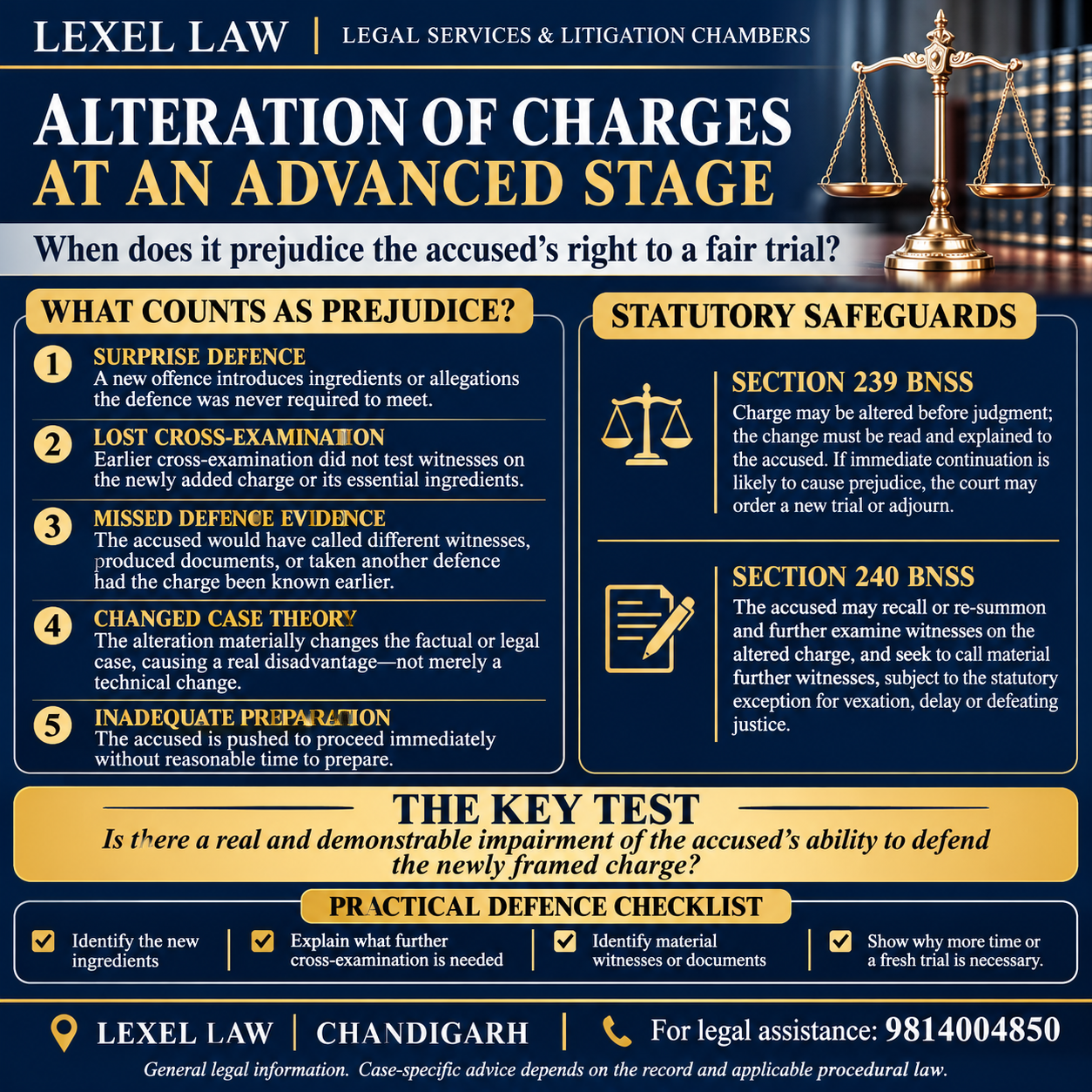
ALTERATION OF CHARGES AT AN ADVANCED STAGE OF CRIMINAL TRIAL: WHEN DOES IT PREJUDICE THE ACCUSED’S RIGHT TO A FAIR TRIAL?
Introduction
The framing of charges is one of the most significant stages in criminal proceedings. It informs the accused of the precise allegations and the offences that they are required to answer. The entire defence strategy, including cross-examination of prosecution witnesses, production of defence evidence and preparation of legal submissions, is substantially influenced by the nature of the charges framed by the trial court.
However, criminal proceedings do not always unfold in a predictable manner. Evidence recorded during trial may reveal circumstances suggesting that an additional offence ought to have been included or that an existing charge requires modification. Recognising this possibility, criminal procedure empowers courts to alter or add charges even after the commencement of trial.
Nevertheless, this power cannot be exercised without regard to the rights of the accused. An alteration introduced at an advanced stage may fundamentally affect the defence strategy and potentially compromise the fairness of the proceedings.
The central legal question, therefore, is whether the alteration merely corrects an omission in the charges or creates a genuine disadvantage that impairs the accused’s ability to defend the case effectively.
1. Statutory Framework: Sections 239 and 240 of the BNSS, 2023
The Bharatiya Nagarik Suraksha Sanhita, 2023 (BNSS), provides the statutory framework governing alteration and addition of charges.
Section 239 BNSS – Court May Alter Charge
Section 239 empowers any criminal court to alter or add to any charge at any time before pronouncement of judgment.
The provision incorporates several important safeguards:
- Every alteration or addition must be read and explained to the accused.
- Where proceeding immediately is unlikely to prejudice the accused or the prosecution, the court may continue the trial.
- Where immediate continuation is likely to cause prejudice, the court may direct a new trial or adjourn the proceedings for such period as may be necessary.
- Where the altered charge requires previous sanction for prosecution, the proceedings cannot continue until the requisite sanction is obtained, subject to the statutory exception.
The provision substantially corresponds to Section 216 of the Code of Criminal Procedure, 1973.
Section 240 BNSS – Recall of Witnesses When Charge Is Altered
Section 240 provides an additional procedural safeguard.
Where a charge is altered or added after commencement of trial, both the prosecution and the accused are entitled to seek recall or re-summoning of witnesses for examination with reference to the alteration.
The parties may also seek permission to call further material witnesses.
The court may refuse recall or re-examination where it records reasons for concluding that the request is intended to cause vexation, delay or defeat the ends of justice.
These provisions demonstrate that although the legislature recognises the necessity of correcting charges during trial, it simultaneously requires the court to protect the procedural rights of the parties.
2. What Constitutes Prejudice to the Accused?
Prejudice is not established merely because a charge has been altered after substantial progress in the trial. The accused must demonstrate how the alteration affects the ability to defend the newly framed allegation.
The assessment must be practical and fact-specific.
A. Introduction of a New Allegation Without Adequate Notice
One of the most significant forms of prejudice arises when the altered charge introduces essential ingredients of an offence that were not previously part of the case the accused was required to meet.
For example, an accused initially facing a charge of voluntarily causing hurt may subsequently face an additional charge involving a materially different allegation or an additional statutory ingredient.
The defence may have conducted the entire cross-examination on the assumption that the prosecution was required to establish the ingredients of the original offence.
If the newly added charge requires proof of different facts, intention, knowledge or a distinct legal element, the accused may be placed at a substantial disadvantage.
B. Loss of an Effective Opportunity to Cross-Examine Witnesses
Cross-examination is a fundamental component of a fair criminal trial.
If the prosecution witnesses have already been examined and discharged, an alteration of charges may create circumstances in which important questions were never put to them.
For instance, where an additional charge introduces an allegation of conspiracy, the defence may need to question witnesses regarding communications, meetings, common intention or alleged participation of the accused.
If the accused is denied an effective opportunity to examine witnesses on these matters, the defence may suffer substantial prejudice.
Section 240 BNSS is particularly relevant in such circumstances because it provides a mechanism for recalling witnesses.
C. Inability to Produce Relevant Defence Evidence
The accused may have selected witnesses and documents based on the original allegations.
An altered charge may make additional evidence relevant or require a completely different defence approach.
For example, where an accused originally faces a charge relating to possession of property but an additional charge introduces an allegation concerning dishonest intention or entrustment, the defence may require documentary evidence, transaction records or additional witnesses to establish the actual nature of the relationship between the parties.
The inability to introduce such material may materially impair the defence.
D. Material Change in the Defence Strategy
A criminal defence is not a mechanical response to the prosecution’s allegations. It is developed after examining the nature of the offence, its essential ingredients and the evidence relied upon by the prosecution.
An alteration that materially changes the factual or legal foundation of the prosecution case may require the accused to reconsider the entire defence strategy.
The court must examine whether the accused had a reasonable opportunity to respond to the new allegation and whether the alteration creates a disadvantage that cannot be adequately addressed through ordinary procedural measures.
E. Denial of Reasonable Time to Prepare
Even where the accused is permitted to recall witnesses, an immediate continuation of the trial may still cause prejudice.
The defence may require time to examine the altered charge, obtain relevant records, identify additional witnesses and prepare further cross-examination.
Proceeding without granting reasonable preparation time may undermine the effectiveness of the statutory safeguards.
3. Important Supreme Court Judgments
Directorate of Revenue Intelligence v. Raj Kumar Arora & Others, 2025 INSC 498
In this significant judgment dated 17 April 2025, the Supreme Court examined the scope of Section 216 CrPC and the circumstances in which criminal courts may alter or add charges.
The Court reaffirmed that the power to alter or add charges is wide and may be exercised at any time before pronouncement of judgment, subject to the statutory requirements.
The Court discussed the principles laid down in earlier decisions, including Anant Prakash Sinha v. State of Haryana, (2016) 6 SCC 105, and Nallapareddy Sridhar Reddy v. State of Andhra Pradesh, (2020) 12 SCC 467.
The judgment emphasised that the exercise of this power must be founded upon relevant material and that the court must ensure that the accused is not prejudiced and receives a fair opportunity to defend the altered charge.
The decision is particularly important because it explains that the power to alter charges is intended to ensure a complete and fair trial, rather than to facilitate an unfair procedural disadvantage to the accused.
Nallapareddy Sridhar Reddy v. State of Andhra Pradesh, (2020) 12 SCC 467
The Supreme Court clarified that the power under Section 216 CrPC can be exercised even after completion of evidence and arguments, including when judgment has been reserved.
The Court explained that the material on record must have a direct nexus with the ingredients of the offence sought to be added or altered.
Importantly, the Court recognised that the power must be exercised judiciously and that the accused must be afforded a fair opportunity to meet the altered charge.
This judgment establishes that the advanced stage of a trial does not, by itself, prevent alteration of charges. However, the procedural consequences of such alteration must be carefully considered.
Anant Prakash Sinha v. State of Haryana, (2016) 6 SCC 105
In this decision, the Supreme Court explained that charges may be altered or added where the material available on record indicates that an offence has been omitted or that the existing charge requires correction.
The Court also emphasised that the accused must be informed of the new charge and the case required to be met so that an appropriate defence can be presented.
The decision reinforces the principle that the power to alter charges must be balanced against the accused’s entitlement to a fair trial.
4. Does Completion of Section 313 CrPC Examination Prevent Alteration of Charges?
An important procedural issue arises where the prosecution evidence has concluded and the accused has already been examined under Section 313 CrPC.
The recording of the accused’s statement does not automatically terminate the court’s statutory power to alter or add charges before judgment.
However, such an alteration may require additional procedural steps.
If the altered charge introduces circumstances that were not put to the accused during the earlier examination, the court must consider whether further examination is necessary to provide the accused an opportunity to explain the incriminating circumstances relating to the altered charge.
The defence may also require recall of prosecution witnesses, further cross-examination and permission to produce additional evidence.
The court must ensure that the accused is not expected to answer a materially different allegation without an adequate opportunity to respond.
5. The Constitutional Dimension: Article 21 and Fair Trial
The right to a fair trial is an essential component of Article 21 of the Constitution of India.
A criminal trial must provide a meaningful opportunity to both the prosecution and the accused to present their respective cases.
The power to alter charges cannot be considered independently of this constitutional obligation.
An alteration that is legally permissible may nevertheless require procedural safeguards before the trial can continue.
The court must consider whether the accused has been informed of the new allegation, whether sufficient preparation time has been granted and whether the defence has been permitted to address the changed circumstances through further examination or evidence.
The ultimate objective is to ensure that procedural flexibility does not become a source of injustice.
6. Practical Remedies Available to the Defence
Where a charge is altered at an advanced stage, the defence should consider taking specific and documented steps to demonstrate prejudice.
These may include:
- Objecting to the alteration: Identify whether the proposed charge is supported by material on record and whether it introduces materially different ingredients or allegations.
- Seeking recall of witnesses: Invoke Section 240 BNSS to recall or re-summon witnesses for further examination on matters arising from the altered charge.
- Seeking permission to examine additional witnesses: Identify witnesses whose testimony has become relevant because of the alteration.
- Requesting an adjournment: Demonstrate why additional preparation time is necessary to meet the changed allegations.
- Seeking a fresh trial where warranted: Where the prejudice cannot adequately be cured through an adjournment or recall of witnesses, seek consideration of a new trial under Section 239(4) BNSS.
- Recording specific prejudice: Explain how the alteration affects the existing defence strategy, earlier cross-examination, documentary evidence or the ability to rebut the prosecution case.
A general objection that the alteration is belated may not be sufficient. The defence should establish the actual procedural disadvantage arising from the alteration.
7. The Judicial Test: Actual Prejudice or Mere Procedural Irregularity?
The decisive consideration is whether the alteration creates a real and demonstrable impairment of the accused’s ability to defend the case.
Not every alteration at an advanced stage amounts to a violation of the right to a fair trial.
Where the alteration merely corrects an omission and the accused is afforded adequate opportunities to respond, the trial may legitimately proceed.
Conversely, where the alteration changes the nature of the prosecution case, introduces new factual ingredients or deprives the accused of an effective opportunity to challenge material evidence, the court must consider appropriate safeguards.
The court must therefore examine the nature of the original charge, the substance of the altered charge, the stage at which the alteration is introduced and the specific disadvantage likely to be suffered by the accused.
Conclusion
The power of a criminal court to alter or add charges is an important procedural mechanism designed to ensure that the trial addresses the offences disclosed by the material on record. However, this power cannot be exercised at the cost of the accused’s right to a fair and meaningful defence.
Sections 239 and 240 of the BNSS, 2023, provide a statutory balance between the court’s authority to correct or modify charges and the accused’s right to respond effectively to the altered allegations.
The Supreme Court’s decisions in Directorate of Revenue Intelligence v. Raj Kumar Arora, Nallapareddy Sridhar Reddy and Anant Prakash Sinha reinforce that the power must be exercised on relevant material and with due regard to the possibility of prejudice.
Ultimately, the legality of altering a charge and the fairness of proceeding immediately after such alteration are two distinct questions.
A charge may be altered within the statutory time limit, but the trial cannot fairly proceed unless the accused receives an adequate opportunity to meet the altered case.
At the heart of criminal justice lies a fundamental principle: no person should be convicted without being afforded a fair opportunity to understand, challenge and defend against the allegations made against them.
LEXEL LAW – LEGAL SERVICES & LITIGATION CHAMBERS
Chandigarh
Phone: 8195048883
Disclaimer: This article is intended for general legal information and academic discussion. The applicability of statutory provisions and judicial precedents depends upon the facts, procedural stage and governing law in each case.